
The Birth of Jonathan Shade

Today (January 11, 2024) and tomorrow (January 12, 2024), the ebook edition of Modern Sorcery is FREE on Amazon. Most of my readers already have it, but if you don’t, this is your chance to grab it HERE. Naturally, if you’re reading this after those dates, you’re welcome to purchase a copy.

Since I’m taking the time to tell you about that, this is a great time to look back at how Jonathan Shade came to be. Warning: this is kinda long. Feel free to skip it, grab a free ebook, and give that a read instead. You can always come back later. If you’ve already read Modern Sorcery, maybe this will interest you.
In high school, I considered myself an artist, so the writing I did back then was just to have something to illustrate. I’d been reading Mike Grell’s The Warlord comics, Fritz Leiber’s Fafhrd and the Gray Mouser yarns, Karl Edward Wagner’s Kane stories, Robert E. Howard’s Conan tales, Michael Moorcock’s Eternal Champion saga, and Mike Sirota’s Ro-Lan series. So, I created a hero named Tim Slade for a comic book series.
Slade was a Hollywood stuntman who thwarted a terrorist attack on the Royal Gorge bridge. Not sure why anyone would target that site, but it was a comic book so there you go. An explosion killed the terrorist and flung hapless Slade through an interdimensional vortex to a fantasy world. There he wooed a young woman named Lucinda (who later turned up in my first short story sale “Mending Wounds”) and made friends with a Sekutar Warrior named Rusoff.
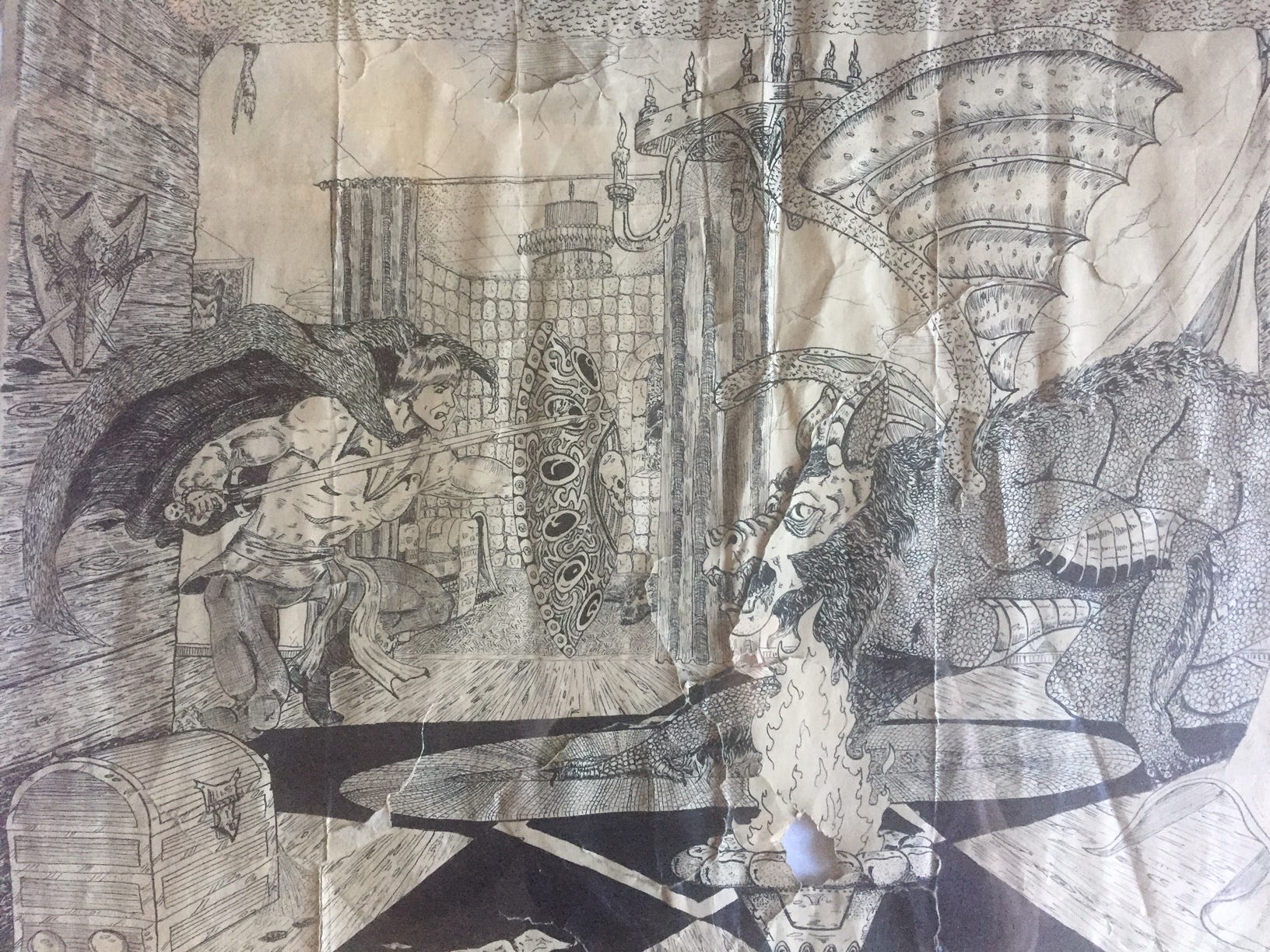
Tim Slade battling a beast (tattered illustration I did back in college)
A few years, later, I took the Sekutar name, revamped it and used it in a novel I started called Heirlooms, which I then turned into a screenplay called Dangerous Heirlooms. I sent the script to Wesley Snipes’ production company in 1992 because I’d just seen White Men Can’t Jump and Passenger 57 so I knew he could handle humor and action. I got the script back with a note saying they wouldn’t read anything not submitted through an agent. That’s just as well because the script wasn’t very good.
Heirlooms was urban fantasy before the genre had a name. I just called it blending genres. Laurell K. Hamilton hadn’t published her Anita Blake series yet, though she’d probably written Guilty Pleasures since it came out in 1993. Granted, there were technically urban fantasy stories going all the way back to William Hope Hodgson’s Carnacki the Ghost Finder stories in the 1910s. I preferred Manly Wade Wellman’s John Thunstone stories from the 1940s, but there you go.
I missed Guilty Pleasures when it first came out, and finally read it in 1998. I enjoyed the book, and it inspired me to take another shot at Heirlooms, which I renamed Modern Sorcery. Initially, I used my Tim Slade character, but the story felt too much like a comic book. It was 500 pages of wandering into episodic action because the character wasn’t invested—he kept finding ways to get out of trouble. He was just a regular guy who got caught up in extraordinary events.
To make the story work, he needed a reason to be there beyond receiving an heirloom from his uncle, a priceless sword handed down for generations or some such—I don’t remember what made the sword so special; I suspect I just liked swords.
In 1999, I was reading a lot of mystery/thriller stuff: Robert Crais, Robert B. Parker, Harlan Coben, Dennis Lehane, and Janet Evanovich. What if I made the protagonist a PI who handled paranormal cases?
At this point, I kicked Tim Slade to the curb because I needed a fresh start. I came up with the name Jonathan Shade so I wouldn’t have the other guy in my head. If Shade was a PI, he’d need a protector. Looking back at the books I was reading, Elvis Cole had Joe Pike, Spenser had Hawk, Myron Bolitar had Win, Kenzie and Gennaro had Bubba, and Stephanie Plum had Joe Morelli and Ranger. I decided to flip it to make the protector a woman, and as I liked my magically engineered Sekutar warriors, I decided she could be one of them.
Because Mickey Spillane’s Mike Hammer had a secretary (Velda—my mother’s name), it occurred to me that Shade could have one, and it might be fun to make her a ghost from a bygone age. I liked the idea of the 1920s because it would give her some pizzazz.
The pieces were now in place. I never looked back at the 500-page monstrosity I’d pounded out. Instead, I started over only retained the title: Modern Sorcery. I set the story in Denver because that’s where I lived at the time.
Jim Butcher’s Dresden Files books started appearing in 2000 while I was trying to write my book, and someone told me I should read Storm Front. I read chapter one and loved it, but Butcher was playing in the same ballpark, and I didn’t want it to influence me. I decided not to finish reading it until I’d completed my first draft.
The problem was that I didn’t finish the book right away. No, I had a publisher interested in my first novel, so I had to clean that up and get it ready for publication. Sadly, that book didn’t sell well. Then life threw some curve balls at me. The big one was when my mother died in late 2002. Since the novel crashed and burned, I switched to writing screenplays. I wrote seven or eight of them in various genres. Two were optioned: a thriller called The Seventh Hour written with my friend Rob Reese, and a family drama called Any Last Requests.
One of the screenplays I wrote during that period was an adaptation of Modern Sorcery and that’s when the story came together. Alas, nobody wanted that script.
In 2005, I wrote a screenplay called Weapon of Choice in collaboration with a local director named Robert Cabrera. He had financing in place to shoot the film locally. He asked me to help produce it, too. Unfortunately, the financing fell through soon after we started filming. When the money ran out, the project died. It was soul crushing.
After licking my wounds for a couple of years, I went back to writing novels. Naturally, I picked up Modern Sorcery and surprise, I liked what I had, and bonus, the screenplay had some good stuff to spice it up. I went to the Pikes Peak Writers Conference in 2007, and read chapter one to an editor named Anne Sowards (she was Jim Butcher’s editor at the time). She asked to see the complete novel, so I finished it and sent it to her.
A year later (traditional publishing can take forever), I got a nice rejection. She loved the action and the humor, but didn’t fall in love with the book enough to buy it. That told me there was something wrong with it, but by that point, I didn’t want to bother with it anymore. I’d been writing for years. Sure, I’d sold a bunch of short stories, one novel, and had a few screenplays optioned, but it seemed clear to me that I was never going to make it as a writer.
I’d lost relationships with a few women I probably could have married because too often I wanted to stay home and write when I should have been spending time with them.
I stopped writing.
A few years later, the Kindle took off, and a friend said I should publish my stuff on Amazon. I ignored him. I was done with writing. Also, around that time I was in a relationship and didn’t want to take time away from my girlfriend. Things were getting serious.
Life loves to throw curves. In late 2010, my father got sick. One afternoon while he was getting a blood transfusion, which would take a few hours, I went to a bookstore and picked up Save the Cat Strikes Back by Blake Snyder. I returned to the hospital and read part of it while my father slept. In the book, Snyder mentioned that when someone doesn’t fall in love with something enough to buy that usually means the character arc is too small so there’s not enough change. I knew that was the problem with Modern Sorcery. I still had no interest in fixing it, though.
My serious relationship ended because I was too busy taking care of my father. Dad died in early 2011. The next day, I got a note from a friend named Maggie Bonham. She remembered hearing me read chapter one of Modern Sorcery at a convention. She was starting a publishing company, and wanted the book and two sequels.
I took it as a sign. I told Maggie I needed to do one more pass on the book because I knew how to fix it. I pulled Jonathan’s character arc back so he’d have room to grow, then turned in the book. It came out in August 2011 and sank like a stone, but I was contractually obligated to write two more books. We can talk about those at a later date.
Remember, Modern Sorcery is here. As I type this, the latest novel in the series is Wicked Shadows and it’s here.
Thanks for reading!